Thursday, February 21, 2008
Tanzania photos, album #2
Check out my second batch of photos from Tanzania! (first batch is on my blog at the beginning of February) Click on the album here to get to a bigger online album to see the photos more clearly.

“You Japanese hate Black Man.”
It was innocent enough. I was walking along Nyerere Street
“Hello, how are you? Come to my shop!”
“Hello, how are you? Come to my shop!”
“Hello, how are you? Come to my shop!”
“Hello, how are you? Come to my shop! Nice paintings.”
“Hello, how are you? Come to my shop!”
“Hello, how are you? Come to my shop!”
“Hapana, asante,” I replied, each time. No, thank you. It is almost a reflex now, since I get typically get bothered several times in a single walk down the street with similar phrases.
“Why not? Come to my shop!”
“Hapana,
“What are you looking for?”
I walk into a fabric store to try to get away from him.
“Want fabric? Come to my shop! I have nice fabric.”
I stop answering him and keep on walking to my destination.
“Where are you from?”
No answer. I keep walking.
“You must be Japanese. You Japanese hate
I looked right at him. He was a young black Tanzanian man with a shaved head, wearing an oversized Timberland shirt and jeans. I said, very sternly, “No, I am not Japanese. I do not hate Black men. Please leave me alone.”
“Yes! You are Japanese! You are Japanese!” he giggled, like he just discovered a new race. He tried to grab me.
I moved away quickly, into the shop associated with the seamstress I was looking for. He continued to harass me about going to his shop until one of the men from the shop managed to kick him out. Much to my sadness, the seamstress was out at lunch, so I had to come back in 15 minutes.
I made it to the corner of
“You, Japanese! You Japanese hate Black man!” He grabbed my arm, and I pulled away in a quick jerk.
“You Japanese MF!” he laughed and pointed at me.
That was the last straw. My seed of anger cracked open with a sprout. I turned around and noted that he was now surrounded by four of his hooligan friends, all staring at me, trying to look tough.
“Do NOT EVER say such a thing to anyone again! I will never go to your shop and buy anything, and I will make sure my friends will not go to your shop and buy anything.”
I turned again and walked into the street to cross it and get away from them. A speeding dala dala almost ran over me, but I sprinted across the street and made it in one piece.
A few minutes later, I told Steve what had happened. Thankfully, he walked back with me to pick up the shirt from the seamstress, just around the corner from that young man’s shop (or really, the shop he “represented”). It turned out that Steve knew the young men at the shop. I wanted to leave as soon as we had figured out that the shirt fit me OK.
“No, come with me,” Steve said. I hesitated. “Come!”
I walked over to the shop with him. The young man came up to us.
“Come to my shop!” he said, looking at both of us.
“I know her,” Steve said, pointing to me.
“You know her! She is the one I followed. You know her?!” the young man said, pointing at me, laughing.
“I know her. She’s a doctor. She told me what you said to her. You can’t say those things to her,” Steve said.
“You shouldn’t say those things to anyone,” I added.
“Oh sorry,” he said half-heartedly. “OK? Come buy at my shop!”
“No! I’m not buying anything at your shop!” Steve said, disgusted.
“Oh sorry,” the young man said again. “OK now? Come in and look at my shop! Just look!” he
attempted again.
I shook my head and walked away with Steve.
Sunday, February 17, 2008
kitenge kraziness!

check out swatches from the kitenge cloth i have purchased from markets and shops in Tanzania! Almost all are made in Tanzania, a couple are made in the Congo.
Saturday, February 16, 2008
Usangi and the Pare Mountains

above: Mama, Juma, and me at the Usangi clinic
 above: Ally and his flapping origami crane; he wants to be a doctor! We'll work to make that happen.
Interesting things happen when the power goes out:
The world gets quiet.
You start to hear each other and the animals and the water and the wind.
You take your time.
Your laptop works.
So here I am, sitting in the dark on a lousy foam mattress with unwashed sheets in my Mhako Hostel room, my spine sinking into the bed, listening to the insects and birds outside, the flying insects inside, the chatter from the bar downstairs of men talking over cigarettes and beer and the noise from battery-powered radios… and typing this on my laptop.
I guess I could have sat in the dark with Guy and Steve downstairs, but being the only female guest in a room full of smoking, drinking, belching men is not very fun – with power or without.
Despite my downgrade in standard of living here, I have been enjoying my stay in Usangi. Usangi is a remote town in the
We are here to start rolling out HIV care to the rural health centres, so that people with HIV from Kagongo can get their care in Kagongo rather than spending 12 hours a day in rough transport and paying half their month’s earnings to get to the Usangi clinic. Right now, there are about 30 patients coming up from Kagongo to Usangi for their care. But the ministry of health suspects that there are at least a hundred more people who need to be in care and treatment in Kagongo. The fishing village is full of young men making lots of cash money from selling fish… and young women trading sex for food. It’s like
Kagongo needs our help to become an HIV clinical site. It only has one clinician and two nurses. The clinician is straight out of school and internship. And one of the nurses is planning to transfer to Moshi as soon as she can. That leaves us with a limited staff with limited experience who need a lot of support to become competent in caring for HIV-positive patients. And HIV is one of the most complicated chronic diseases to manage.
We’re making it happen. Here’s how: the health centre staff gets a week-long HIV/AIDS training session. A few weeks later, we bring them up to the district HIV clinic in Usangi to see first-hand how the clinic works and to work with an experienced staff member from the Usangi clinic. We (the UCSF TZ crew) train the Usangi staff to mentor the Kagongo (and Kifula) health centre staff for at least two clinic days in Usangi. We also do a bit of teaching for all staff and some direct mentoring when we see mistakes in clinical practice. After we ensure that the health centres have infrastructure (rooms, furniture, medications, forms), we start transferring some of the patients seen at Usangi to their local health centres. The Usangi site sends a clinician and a nurse down to the health centre during their clinic days to mentor them twice a month. Once the health centre staff feels ready to take off their training wheels, they start having clinics on their own, and the Usangi staff comes to mentor and monitor quality once a month. The Moshi EGPAF Tanzanian staff also visit periodically for quality control. We do a follow-up visit in about half a year.
This model of intensive mentoring is new in
We have a good team now at the Usangi district hospital; they are key in making this plan work. Previously the Usangi site was one of the least organized, but now with Makapa Fellows (Tanzanian superstars picked and hired by the Global Fund given higher salaries to work in remote and rural areas), the site has improved tremendously. It makes an enormous difference for my quality of work to be able to mentor and teach a staff that is interested in learning and developing their skills. It is also a treat to be able to work with smart, savvy Tanzanian women like Tersesia Kasunga – the Makapa clinician that spends most of her time working in the HIV clinic in Usangi. She’s a quick learner and very good with patients – traits that I wish I could find more often in other clinicians.
It was quite gratifying after last week’s fiasco in Karatu to show up on the first day in Usangi and see 15 eager health centre and Usangi staff wanting to learn more about HIV care and treatment. Then the health centre staff stayed to get mentorship from Usangi staff on their two clinic days. We visited the Kifula and Kagongo health centres today to ensure that they have what they need to start seeing patients. And on Friday we will put together a roll-out strategy and work plan for the district. This is exactly what we came to do. Imagine being able to do it! So nice.
Tanzanian travel peeves
Pet peeve of the moment #1
Would you sleep on a sponge?
I didn’t think so. The foam mattresses here in
Pet peeve of the moment #2
How does it feel to be treated like a second-class human being all the time?
It’s bad enough to be a woman here in
I am facing an uphill battle with wanting respect as a small-sized, loud-mouthed Asian American female physician. Since I have been traveling with Guy (a very very tall white Dutch American man) and Steve (a relatively tall African American man), most Tanzanians get confused when I am introduced as the doctor, Guy is introduced as the nurse, and Steve is introduced as the peer educator. I’m happy to encourage people to challenge their stereotypes, sexism and assumptions, but dammit – it is hard work!
Sunday, February 10, 2008
Kazi Safari: a different kind of work adventure
 above: mama and mtoto (child) at the Karatu district hospital
My fourth week marked the beginning of a very different work experience. Guy Vandenberg, a nurse and social worker by training, Steve Williams, peer educator, and I are now traveling to different district sites in the Arusha and Moshi Kilimanjaro regions to assist them with the rural health centre HIV care roll-out process. Team TZ (what we call the group of folks from UCSF who come to
MOMI is really what it sounds like. We are “mommying” (mothering) some of the HIV Care and Treatment Center (CTC) leaders to become better leaders and to help them train lower-level health centre staff so that the rural health centres can also provide HIV care and treatment. This sounds simple, but Tanzanian bureaucracy and politics makes it incredibly challenging. Karatu is a perfect example of this.
Our first MOMI site was
When we arrived, we had the mandatory meeting with the District Medical Officer (DMO) and the CTC-in-charge. The DMO was supposed to be notified at least a week in advance so that he could arrange for us to work with health centre staff. The CTC-in-charge failed to notify him, so nothing was arranged for us. And after we requested him to arrange the visits, he still did not arrange them. (We can’t arrange them on our own because we don’t know whom to contact, so we are beholden to the Tanzanian DMO or clinic administrator to do this for us.) Not-very-smart move #2.
The CTC-in-charge, Elitumaini Mziray, is the key person that we were going to groom as a mentor of the health centre staff. We found out on the day we arrived that he was going to be gone during the week. Not-very-smart move #3.
In summary, nothing was arranged or organized for us, no one knew we were coming to train them, and the key person I was going to train was gone during the time we were there. Awesome. How does one get work done in this setting?
On top of all this, the medical officer I was left to work with is a sexist buffoon who continuously referred to me as “the mzungu” (“the whitey”) instead of my name. And he even argued with me in front of a patient when I asked him to call me my proper name and that I am Asian, not white. This is not even to mention that he had a terrible bedside manner and made some flagrant medical errors. I think I picked out over a dozen instances that would have clearly constituted medical malpractice in the
Then, on the last day, I found out from a patient that the clinic had run out of Efavirenz for the last TWO months, a key HIV antiretroviral that many patients (particularly those with TB) have been on. Instead of telling anyone about this, the pharmacist simply failed to give the patients the drug or switched it on his own to another antiretroviral. And let me tell you, he doesn’t know squat about managing HIV. None of the clinicians there admitted to knowing about this. There was no clear plan on procuring the drug either. This is what we call a total disaster.
Can someone poke my eyes out? I’ve already pulled my hair out.
Patience.
Letting go.
We did the best we could. Guy worked with Mama Agnes, the lovely and caring but incredibly overstretched nurse, who is a victim of her culture’s ingrained sexism. I tried to teach the medical officer some proper ways to manage cryptococcal meningitis and TB-HIV coinfection. And happily, we identified a motivated, smart young women clinical officer who was interested in becoming an HIV clinician. I taught her how to initiate patients on HIV antiretrovirals. We summed up our findings and recommendations in a dense document and presented it to Elitumaini. He made a work plan with us to tackle some of the problems. We really hope these things happen. Or the HIV-positive patients in the Karatu district are in serious trouble. At least I know that our support for them will only make a positive difference at this point - there is no other direction left to go.
Speaking of hope (a liability and an asset), I hope the next three sites are in better shape.
Tanzania Kazi: work
What am I really here to do?
A couple principles to keep in mind while working here:
-Our ultimate goal here is to make ourselves unnecessary.
-It is not impossible to get things done; it just might take much much much longer than you would ever expect.
The first three weeks of my time in
The first training was in Tabora, at
It was my first time as a trainer in this group – Royce Lin was the lead trainer (he’s done this training many times already), and we had a few Tanzanians doing pieces of it: Elitumaini Mziray taught about HIV drugs and neurological complications; Amos Nsheha taught about pediatric disclosure issues; Werner Schimana (a German ex-pat) taught pediatric HIV drug issues. I taught a big section on pulmonary complications of HIV (TB, PCP, bacterial pneumonia), which I must admit was a big hit, as well as a difficult section on treatment failure. The usual Sub-Saharan African snafus happened, including several power outages (after I had spent hours putting together a great slide set of chest x-rays, etc.) and hospital meetings in our training room that went an hour over its slated end time, thus delaying us for an hour.
This is an exercise in patience and in letting go.
I remind myself of this often.
There are some absolutely awesome parts of this type of teaching, such as seeing nurses doing a perfect pulmonary exam and asking the appropriate sexual history questions and speaking out about the treatment of TB to clinicians who are doing it incorrectly.
The second training was with the Elizabeth Glazer Pediatric AIDS Foundation (EGPAF, whom we are sub-contractors for here in
Bagamoyo Represent!
 above: sculptor Omari and me at the Seaview Sculpture Arts Center
Bagamoyo: lay down my heart
Aside from the eau-de-poo water, Bagamoyo is a pretty darn cool place. It’s a crying shame that I had to work from about 8 am to 8 pm (or sometimes later if folks decided to talk about work over dinner and after…), thus preventing me from really exploring the town. I was released from work duties on Friday afternoon and spent the rest of Friday and Saturday wandering around this ancient seaport, slave trade and coastal center.
The Swahili name of Bagamoyo has multiple interpretations, ranging from “lay down my heart” as a place of rest for weary travelers from inland and ocean routes – to “crush my heart,” spoken by people taken as slaves when they arrived to the port of Bagamoyo, because it meant that they were certainly going to Zanzibar to be traded and sold as slaves. There are remnants of the old Swahili culture, including the 13th century ruins of Kaole, which mainly consists of surviving coral-rock tombstones of inhabitants. The inscriptions, in Arabic, are still present on a number of tombstones. Tanzanian political candidates, particularly presidential hopefuls, make it a point to visit “Sharifa’s grave” – the burial site of a four-year-old girl who apparently performed miracles when she was alive and continues to grant wishes. Perhaps we should send Obama to Sharifa’s grave.
In town there are reminders of Bagamoyo’s past as a key transit point in the East African slave trade: the customs house and Old Arab Fort, a holding cell for slaves while they wait for their boat to Zanzibar. A few abandoned sites of German colonial rule remain (though quite run down), including the old Boma and Liku House, the headquarters for German East Africa. Since there is no money put into the preservation or the destruction of these old buildings, it’s similar to observing the natural history of untouched abandoned buildings.
At the Seaview Sculpture Centre, Royce and I met sculpture artists Shibani and Omari. We each bought pieces by them. I quite enjoyed Omari’s work. He takes wooden poles and carves the faces of the moon spirit into them.
The Bagamoyo College of the Arts (Chua cha Sanaa) hosts a showcase of student performance every Friday night. I went with Trinidad (an artist from Spain whom I met on the British Air flight from London to Dar) and Philipa (from Portugal), who are both volunteer teachers at the Seaview Sculpture Centre. A bunch of their students were drumming and dancing as part of the Friday evening show. See the previous post for a video and description.
Saturday, February 2, 2008
Bagamoyo Uhuru dancers!
This is a low-res (point and shoot camera) video i took yesterday night at the Bagamoyo Arts College (Chua Cha Sanaa) weekly performance. There was some really great work by young artists, including the young people in this piece - a group called the Uhuru (freedom) dancers and drummers. Sadly, the sound on my camera is not working, so i had to splice it with a Gilberto Gil song to give it a beat.
Many of the artists presented work that was a good mix of traditional and modern influences. The video shown here was more traditional in drumming and dance style - though it's always interesting to see what people do for their dance outfits. In this case - colored plastic straw skirts over boxer shorts for the men... and t-shirts and tank tops with cotton wrap bottoms for the women. The video might make it look like a dorky college cultural show, but i assure you that it was way cooler. ;)
The best part of this performance was that it was in an outdoor amphitheater on the beach, and the audience was filled with folks from the Bagamoyo community - bibi, babu, watoto (grandmas, grandpas, children) were all present. It's great to see the community all come out and participate and enjoy the creative work of its young people.
There were only a small handful of wazungu (foreigners), including myself and a bunch of the volunteer art teachers from Spain and Portugal whom i'd met and befriended on the plane ride over from London to Dar 4 weeks ago. It's a small world after all!
Tanzania photos, album #1
Please click on the teeny slide show above to see the bigger version and/or individual photos more clearly. Asante!
Friday, January 25, 2008
Tabora Town: Kenya vs Tanzania, mosquito mania
The on-going political violence in
Today (my “lazy day”) I purchased English versions of two Tanzanian newspapers, The Citizen and The African and curled up in my sitting room wicker chair to read what they had to say about the situation in
“
The article proceeded to describe how US economic and political interests are pressuring the Kibaki camp to be more forceful in staying in power. A couple of professors at the university in Dar explain that Kibaki has been willing to give in to US interests of establishing a base there from which to monitor eastern and southern Africa’s “terrorist” activities. Apparently the
From what I can tell, the Tanzanian papers have been criticizing Kibaki for inflaming violence, for not taking Odinga’s support seriously, and for not conceding to the popular vote – and at least a recount or revote. They view Odinga’s party as being more organized and more a representative of “the people.” They can’t see how the violence will resolve if Kibaki is stays in power.
Tanzania vs Kenya
I have often felt a subtle undercurrent of desperateness and restlessness in
On the whole, I’ve found
Sadly the policy turned out to be an economic disaster, as it left lots of fertile land unused and bred corruption probably like that I’ve seen in China. However, it served the function as nation-building- and folks here seem to some amount of access to education, clean water and health care. The literacy rate is over 90%. And people have less of the tribal and religious conflict I’ve seen in
“We are very different here in
Tanzanians are proud of this history, one in which people have learned to retain their tribal heritage but not become ruled by it; one in which people have seen the good that comes from collective hard work.
Mosquito Mania
I am putting 100% DEET on my hair and face at night. That’s BAD. The mosquitoes here in Tabora during the rainy season (as it is now) are numerous and aggressive. They have a strong will to suck my blood and make eggs and reproduce and suck my blood in increasingly exponential quantities. And they like my blood. I get huge welts as a result of bite, so you can imagine how ugly I get with 20 mosquito bites fighting for space on my legs.
All I have to say is: hurray for DEET, hurray for malaria prophylaxis!
Sunday, January 20, 2008
Tabora Town: going local
I am typing in my very own sitting room verandah in this small city’s only fancy hotel, the Orion Tabora. Outside are the intermingling sounds of people speaking Swahili at their bar, Marvin Gaye’s “Sexual Healing” (for the third time in the last hour), a man singing prayer at the nearest mosque, frogs, crickets, turtles munching on plumeria flowers, rain, and the crazy whooping and whistling of African gray mimic birds.


above: turtle munching plumeria flowers outside my front door
There are few barriers to life here: other peoples’ lives, nature, community. This is so unlike the isolated enclaves of the Coral Beach Hotel in
** a couple days later…
The Tabora Sound Band
The Tabora Sound Band has been rocking the Orion Hotel for the last three hours. They will likely play for three more hours – it’s midnight. My room is directly in back of their stage, so you can imagine that with their new ten-speaker system, it’s a bit loud. It’s a good thing they’re good musicians, and I like their style: lots of smooth Swahili singing and intricate guitar picking over a danceable bass. Very African, very fun.
Royce and I have cut a few tracks on their nice wooden parquet dance floor. Tanzanians dance very conservatively (at least among the older set): men dance with other men, women dance with other women, men and women don’t touch each other. It’s an interesting traditional-conservative + slightly homoerotic gathering. One night, a man grabbed Royce’s hand to come up to dance. I eventually joined them on my own (it would be scandalous for a man to invite me), along with four other of the men’s drunk friends. They are generally very respectful of me, keeping distance, until one mildly drunken moment of holding onto each others shoulders and singing together. I’m pretty sensitive to strangers’ touches, and only then did I feel a slight violation of personal space. On the whole, it’s a very tame scene.
Amazingly, I’ve been able to fall asleep while the Tabora Sound Band is still playing. I’ve been exhausted from my daily forays into the world of kitenge (colorful, patterned East African cloth) and tailor-made sewing projects. It’s a bit dangerous to put beautiful fabric and affordable tailoring into my hands. I’ve gotten the idea to make all sorts of craft-sewn items of my design; since I’ve always been limited by my lack of sewing machine skills, I can now hire tailors to make my designs for me. What luxury!
Arts ‘n’ crafts in rural
and
a Tanzanian family’s home
Part of the fun is hunting for kitenge in the street market and bargaining in my recovering Kiswahili. The following comprises most of the Kiswahili I’ve regained so far besides “maji biridi” (water, cold):
Jambo, habari yako?
Nataka kitenge?
Ni bei gani?
Elfu tano mia tano? Ni gali sana!
Nitakupa shilingi elfu nne.
[Hello, how’s it going?
Do you have kitenge?
How much is it?
5,500? That’s too much!
I’ll give you 4,000 shillings.]
Yes, the vocabulary of a cheap market shopper. In the end, I don’t bargain hard (at least not like I do in

above: detail from two kitenge fabrics and one kanga
So now a young woman named Petty is making a tunic dress and a skirt out of some funky purple and black fabric and an older man (whom Valerie knows as “the father of Omari”) is making a market bag (so I can accrue more fabrics, naturally) out of a deep turquoise and brown butterfly kitenge. Man, these kitenge and kanga designers are artistic geniuses!
Today I went to their homes in the national housing district by bicycle taxi.

above: Father of Omari with the butterfly kitenge and antique sewing machine from China!!
Now you may ask:
How in the world did I know whose houses to wander into?
And what is national housing?
National housing is apparently government-provided homes for Tanzanians who have served in the military or in public office at some point in their lives. I don’t know this for sure, but national housing might be a vestige of Nyerere’s socialist principles in ensuring that people have shelter, especially if they’ve served the country in some way. It seems to be very much a working class black African district: very basic, dirt roads, but still with permanent concrete dwellings, electricity and limited running water.
I spent the afternoon there with Valerie, her family, and her neighbors who happen to be tailors.
Valerie is a young woman who works at the small snack shop and internet café at the Orion Tabora Hotel. She was wearing a gorgeous dress made out of a kitenge this morning. I initially walked up to her to ask her about the internet access at the shop (which hasn’t been working for the last week) and then noticed her awesome dress. Petty had made it for her. When I enquired about good tailors she could recommend, she instructed me to purchase the kitenge I wanted to use, then meet her back at the hotel at 2 pm. I ran into town, found my kitenge, and went on a national housing safari (journey) with Valerie.
We took bicycle taxis along these crazy pot-holed dirt roads. Now these are not the suped-up boda boda bicycle taxis of
By far the most memorable part of the trip was having lunch with Valerie’s family. Unexpectedly, she invited me to her family home after we dropped off the fabric and projects at Petty’s house.
“Come, let’s have lunch at my home,” she said.
“Sasawa,” I said. OK!
So we went into an alley next to Petty’s house, past a bunch of chickens and a group of children playing in the dirt patch and thinking of clever things to say to me in English.
“Hello, how are you?”
“Good day, Madam!”
“My name is Mfana!”
Valerie’s house is humble and friendly: concrete floors and walls, plain wooden doors, windows with hand-crocheted lace curtains and simple furniture adorned with crocheted doilies and hand-knitted stuffed animals. They have a tiny television and were watching some local beauty pageant on it when I entered the main family and dining room. Valerie’s uncle, older brother, two younger brothers, mother, grandmother and grandfather were all there. They were patiently waiting for Valerie to return home for lunch. They didn’t eat until we came in, and everyone made proper introductions with me. I bowed and said a shikamoo (respectful greeting to elders) to Valerie’s grandparents. Her babu (grandfather) gave a hearty belly laugh and held my hand warmly. Karibu
We ate ugali with stewed greens and red beans. It was a perfect meal for me: fresh, vegan, hearty. And I liked their ugali. I guess that I haven’t liked it in the past because I’ve just had bad, soggy or cold ugali. Ugali is white corn meal mash, kinda like a super bland, super fine polenta. Eating this local food with my fingers and sharing it among people who so warmly invited a stranger into their home represented all things good in the world.
Afterwards, Valerie asked me if I enjoyed the meal. I told her that it is one of the best meals I’ve had. She laughed and told me that it can’t be true. But it is.
Wednesday, January 16, 2008
Karibu Tanzania! Assport Control and the Pilipino Double Delight

My arrival in
The visa application area was total chaos. A crowd of confused, tired and cranky tourists (mostly from Europe and Canada) and a few NGO workers milled around three random-seeming Tanzanian dudes who took our $100 bills and our passports and put them in a dubious pile. Miraculously, they called me to the processing window, took a digital (!!) photo of my exhausted face, and pasted a very official and clean-looking visa with my photo into my passport. And they didn’t ask for a bribe or over-charge me.
Next was the Assport Control. They forgot the pee. I breezed through this one too. It was my lucky day!
My three days in
Dar Adventure Number One: The Pilipino Double Delight
There’s nothing like 22 hours on a plane to make your body feel like total crap. Add wailing children and rude seat neighbors and then you feel like über-crap.
My first quest was to find “The Touch” spa. I saw a sign for it on
I found a big house with a sign “The Touch” at the gate. The askari (guard) was fast asleep, so I just walked right in. As I turned the knob on the door, out walks a tiny Pilipina woman, about my size. We were both shocked at seeing each other. After a moment, I asked “Is this ‘The Touch’ spa? Do you do massage?” She smiled and nodded and shooed me inside.
It turns out that “The Touch” consists of four Pilipinas who came to Dar seven months ago to set up this day spa. I asked for a back massage and decided that I’d have to save the “Gentleman’s Executive Relaxation” and “Pilipina Double Delight” for another day. That’s when you have two Pilipinas “working on” you at the same time. The whole thing was hilarious. The women there, especially Mimi, who gave me my back massage (and did a good job, thank you), thought that the whole situation was hilarious. I could hear them chatting and giggling up a storm in Tagalog while I was lying on the table in post-massage relaxation bliss.
Dar Adventure Number Two: Kariakoo Market Chaos
After our meeting with the folks at I-TECH in downtown Dar, I wanted to explore the Kariakoo Market. It is touted to be one of the biggest and brightest markets in all of
We encountered a surreal scene. The market building had a bunch of its portals closed. No on was visibly selling market stuff on the streets. Debris was strewn all over. There was an agitated feeling in the air. Men were angrily milling all about without any directed purpose. The market seemed closed, but something was wrong.
We walked into a nearby ice cream shop and asked the man behind the counter about the market. Royce asked him directly, so I couldn’t hear much of the response, which was in broken Swahilish anyway. Royce said, “Oh, something happened to a small businessman…” which somehow I had heard as “something happened to a small child.” We left feeling even more disoriented and found a taxi.
I asked Modest about it that evening. “Oh, they are just cleaning up the market area with the small vendors. They should be open tomorrow.”
The next day, the front page of the Tanzanian papers declared, “Kariakoo Market Closed Indefinitely.” The news showed scenes of total chaos at the market with crowds of men toppling tall piles of market goods in the face of Tanzanian police officers. It turns out that the police are trying to crack down on the small vendors and won’t allow the market to re-open till the small vendors leave the premises.
The market probably thrives on these scrappy small vendors. Why on earth would you want to drive them away?
Check it out:
www.tzuk.net/index.php?option=com_content&task=view&id=5551&Itemid=39
Thursday, January 10, 2008
London re-Impression
My first re-impressions of London:
-> Everyone smokes!
-> Black and brown people get seriously detained and interrogated by other black and brown people at immigration. (Self hate is deep!)
-> I get easily lost in most places. I blame it on my left-handedness and poor sense of direction. In London, I get ridiculously lost. Despite studying the map and memorizing the streets and asking people for directions, I got lost going to Harvey Nicks department store from my B&B, which is straight along one major road. How on earth did I do that?? It’s the London curse on the directionless.
-> I would starve here.
Welcome to the first world, Baby.
My plane ride from the first world (US) to the firster world (UK) was exhausting. I turned down the economy plus upgrade because it cost $119. Boy, am I sorry I did that. My seat was in the same row as a cranky 6-month old and a wailing 2-year old and big parents who used my seat space… in back of another two small children, and worse, directly in back of a snooty stale-cigarette-smelling young British couple who pushed their seats all the way back and proceeded to bounce around in them so that the seat in front of me actually hit me in the knees and head several times. Try working on your laptop in this situation!
But no medical emergencies on that 11 hour flight. Whew! I had been eyeballing a few elderly folks who didn’t look so good when I boarded. We all made it. Yay!
I am happy to be off the plane and in South Kensington. But unless I eat a sandwich for every meal at the Pret a Manger chain (because they have fresh veggie options), I may starve. My eating adventure tonight was at “Yo! Sushi” a chain of sushi boat restaurants. This one was the hipster one at the Harvey Nichols (or “Harvey Nicks” if you want to sound like you know something about shopping). I spent the equivalent of US$20 on dinner… and one hour later, my stomach is growling angrily at me! So after exploring all five floors of Harvey Nicks and finding absolutely nothing that I like (can someone explain to me why women will spend $600 on Jimmy Choo shoes?), the only thing I bought is a bag of parsnip chips for 75 pence. Apparently they were grown in Field Garden, Devon (the parsnips, that is) and fried by a man (or a manly woman) named Cliff. Parsnip chips are hella good. They are a much better value than the $7 for 3-pieces of stale crayfish and rocket maki that I ate for dinner. Unfortunately, parsnip chips only represent one food group: fats and sugars. Same with the Hob Nob cookies that I so love. So I will need to find something else to supplement my British diet.
If there’s one thing I love about London, it’s the museums. The fact that they’re “free” to the public and well-supported by the government and funders shows how dedicated places like London are to preserving culture and arts. Viva public art support!
In fact, the Victoria and Albert Museum, which is a five-minute walk from my B&B, is featuring a show on “Spectacular Craft.” It’s exactly the type of work I love to see and make: hand-made crafts discussing modern and environmental issues. Whoo hoo… field day for me.
Check it out:
-> Everyone smokes!
-> Black and brown people get seriously detained and interrogated by other black and brown people at immigration. (Self hate is deep!)
-> I get easily lost in most places. I blame it on my left-handedness and poor sense of direction. In London, I get ridiculously lost. Despite studying the map and memorizing the streets and asking people for directions, I got lost going to Harvey Nicks department store from my B&B, which is straight along one major road. How on earth did I do that?? It’s the London curse on the directionless.
-> I would starve here.
Welcome to the first world, Baby.
My plane ride from the first world (US) to the firster world (UK) was exhausting. I turned down the economy plus upgrade because it cost $119. Boy, am I sorry I did that. My seat was in the same row as a cranky 6-month old and a wailing 2-year old and big parents who used my seat space… in back of another two small children, and worse, directly in back of a snooty stale-cigarette-smelling young British couple who pushed their seats all the way back and proceeded to bounce around in them so that the seat in front of me actually hit me in the knees and head several times. Try working on your laptop in this situation!
But no medical emergencies on that 11 hour flight. Whew! I had been eyeballing a few elderly folks who didn’t look so good when I boarded. We all made it. Yay!
I am happy to be off the plane and in South Kensington. But unless I eat a sandwich for every meal at the Pret a Manger chain (because they have fresh veggie options), I may starve. My eating adventure tonight was at “Yo! Sushi” a chain of sushi boat restaurants. This one was the hipster one at the Harvey Nichols (or “Harvey Nicks” if you want to sound like you know something about shopping). I spent the equivalent of US$20 on dinner… and one hour later, my stomach is growling angrily at me! So after exploring all five floors of Harvey Nicks and finding absolutely nothing that I like (can someone explain to me why women will spend $600 on Jimmy Choo shoes?), the only thing I bought is a bag of parsnip chips for 75 pence. Apparently they were grown in Field Garden, Devon (the parsnips, that is) and fried by a man (or a manly woman) named Cliff. Parsnip chips are hella good. They are a much better value than the $7 for 3-pieces of stale crayfish and rocket maki that I ate for dinner. Unfortunately, parsnip chips only represent one food group: fats and sugars. Same with the Hob Nob cookies that I so love. So I will need to find something else to supplement my British diet.
If there’s one thing I love about London, it’s the museums. The fact that they’re “free” to the public and well-supported by the government and funders shows how dedicated places like London are to preserving culture and arts. Viva public art support!
In fact, the Victoria and Albert Museum, which is a five-minute walk from my B&B, is featuring a show on “Spectacular Craft.” It’s exactly the type of work I love to see and make: hand-made crafts discussing modern and environmental issues. Whoo hoo… field day for me.
Check it out:
http://www.vam.ac.uk/vastatic/microsites/1637_outoftheordinary/index.php
Monday, January 7, 2008
Christmas & New Year -with Aloha- in O'ahu, Hawai'i!
Our Choi family holiday gathering was almost everything I could wish for: good family folks, fun holiday gatherings, good Asian food, warm and friendly strangers who took me in like their own, crazy kiddie escapades - such as naked time pee pee and the sugar special seen in the video below.... and the beach, sunshine, tropical storms, rainbows, adventures in Spam musubi and poi hunting, wiping out on a boogie board and eating sand, and then swimming with turtles in the ocean. The only thing missing was that not ALL of my good friends and family could be there. Besides that, THIS is what I call a perfect holiday!
Pupule (KrazEEE) Hawaiian Adventure Pictures to come wiki wiki (fast)!
Pupule (KrazEEE) Hawaiian Adventure Pictures to come wiki wiki (fast)!
Saturday, January 5, 2008
De-bunking third world myths with the best stats presentation ever!
Aloha from Hawai'i. I am being silly and exploring nerdy visual-design-data resources online while the sun, ocean, beach and valley beckon outside. Before I turn off this computer, I want to share this awesome resource with y'all (which my neighbor-friend Brian Sullivan sent to me):
http://www.gapminder.org/world/
http://www.gapminder.org/world/
Thursday, August 9, 2007
Galapagos Adventure Video!
The Nemo Nemo Galapagos Video has been released!
Disclaimer: Young Whan edited this video (and did a fab job) and i was only a consultant, so i am not responsible for the bizarre footage of the marine sophy and the sleepy sophy.
Disclaimer: Young Whan edited this video (and did a fab job) and i was only a consultant, so i am not responsible for the bizarre footage of the marine sophy and the sleepy sophy.
Monday, August 6, 2007
Monday, July 30, 2007
Galapagos Photos & Slideshow!
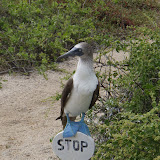
Click on the link below to check out the photo album from the Galapagos Islands or watch the slideshow here. It's crazy how close you can get to the animals there. They haven't evolved to run away from humans... yet.
 |
| Galapagos - Nemo 1 Adventure - July 2007 |
Sunday, July 29, 2007
Galapagos Adventure

The Galapagos Top Five [Cool Things]:
1. The scariest looking animal was the vegan, salt-spitting marine iguana. 2. The biggest oldest land animals were the vegan land tortoises.
3. Swimming with penguins at the equator. So Galapagos.
4. Baby sea lions. So Cute. So Kawai.
5. Batfish. The Tammy Faye Bakker of the marine world. This creature has big thick black eyelashes, blood-red lips, little legs it scuttled around on, and a winged body. And it praises Jesus in a world where Darwinism rules. See the photo below.

Honorary Cool Things:
-surviving 8 days on a boat only slightly sedated and confused on scopolamine... but not barfing a single day!
-best animal name: nudibranch.
-that the clumsy, careless blue-footed boobie has survived natural selection to this day. i guess Mother Nature has compassion too and endowed the Galapagos with next to no predators.
-Victor's AWEsome multi-course feasts for us on the boat - none of the meals on the 8 days was exactly the same. He even accounted for my lactose-intolerant pescaderian-vegetarian diet. And fresh jugos every morning! Victor was our boat chef.
-Mauricio's AWEsome dry-erase marker drawings of our itinerary and elaborate, articulate, knowledgeable explanations of the zany place that is the Galapagos. Mauricio was our naturalist guide.
-Mauricio's way of radio-ing for the "Nemo Nemo" crew to come pick us up on the islands.
-Jonathan's amazing ability to clean our tiny, salty, smelly submarine rooms into pristine, neat homes away from home. Jonathan was our super-nice, super-charming helper-outer.
-fun folks from Ecuador, Holland, Germany (via Argentina), Italy, Israel, Florida, Utah and good ol' California.
Subscribe to:
Posts (Atom)